The Casino in the Painted Backdrop
Casino imagery in painting can suggest glamour, risk or uneasy performance; learn how to read its visual cues without mistaking a backdrop for a record.
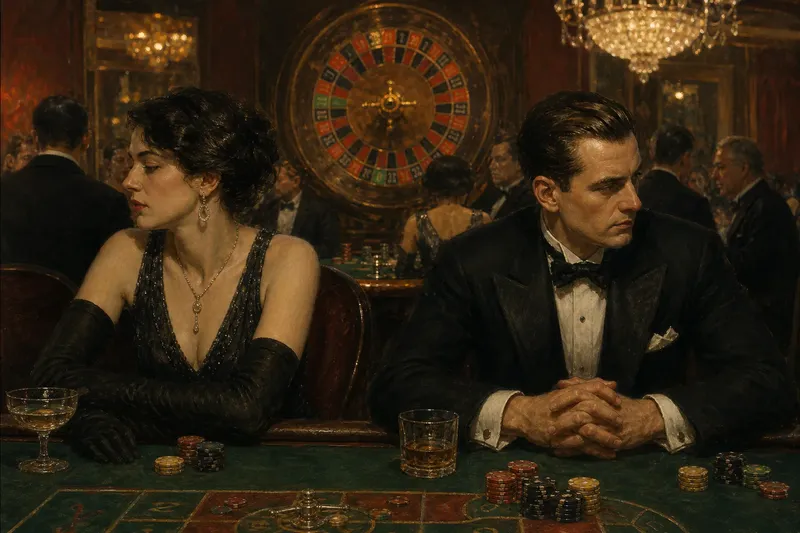
A painted roulette wheel glows behind a couple who seem to have stopped speaking. The room may resemble a casino, but the image has not promised us a real address, a date or even an accurate table. Casino imagery in painting is often more useful as a stage set: it tells us how an artist wants chance, money and company to feel.
That distinction helps when deciding what to look at. A reader seeking social history should ask different questions from someone studying colour or popular taste. The painted casino can carry clues, but its strongest evidence is usually about visual imagination, not the details of a venue.
Read the backdrop according to what you want to know
Begin by deciding what kind of claim the picture might support. A stylised room can offer a rich account of mood, convention and fantasy. It is much less dependable as a floor plan or a report on everyday behaviour.
- If you want to understand composition, follow the arrangement of tables, figures and lights. Ask what the setting makes the eye notice first.
- If you want to understand a social ideal, look at clothing, posture and who is allowed to occupy the foreground. Treat these as choices made by the image, not a census of casino visitors.
- If you want to identify a particular venue, seek corroborating material such as a known image source, a legible sign or reliable provenance. A roulette wheel and a chandelier are not an address.
- If you want to read popular imagery, compare the painting with posters, magazine illustrations or film stills from a relevant context. Repeated motifs may reveal a shared visual vocabulary.
Each route keeps the picture in its proper job. The backdrop is not a window that simply happens to be colourful; it is an arrangement that directs interpretation.
Separate visual suggestion from documentary evidence
Paintings often compress a place into a handful of recognisable signs: a gaming table, a dressed-up crowd, a bright fixture, perhaps a card or wheel. Those signs can make a scene readable before the viewer has worked out who is there. They also leave much unsaid.
A room may be invented, combined from several references or altered to suit the composition. Even a recognisable building can be represented selectively. The artist may omit ordinary furnishings, crowd the scene for energy or place a game where it serves the story rather than where it would have stood.
For that reason, distinguish three things as you look: what is visibly present, what the visual cues suggest, and what you would need outside evidence to establish. “A roulette wheel appears beside a group in evening clothes” describes the image. “This was a particular casino on a particular night” asks for evidence the painting alone may not supply.
That is not a reason to dismiss the scene. A constructed setting can still tell us how casino life was imagined, advertised or satirised. It simply answers a different question from an architectural record.
Let lighting and colour set the terms
Light is often the quickest way to see what role the casino backdrop plays. A bright table isolated against a dim room can make the game feel like the scene’s centre of gravity. A glittering space with small, shadowed figures can instead turn the venue into spectacle, with people reduced to part of its decoration.
Colour can sharpen that effect. Golds and reds may suggest ceremony, warmth or display, while a colder palette can make the same polished room seem distant. These associations are not fixed rules. Their force depends on how the artist uses contrast, shape and surrounding detail.
Look for where the strongest highlights fall and whether they lead towards a person, an object or an empty patch of room. A polished surface may draw attention to the table, but it can also make the people seem watched or exposed. The difference often lies in the figures’ faces and how they relate to one another.
Use figures and objects to read the social script
Notice who appears to be playing, watching, waiting or merely passing through. A painting may give one figure control of the table while others hover at the edge. That arrangement can suggest status or exclusion without proving how a real room operated.
Clothing, gestures and distance between figures are similarly useful as visual choices. Formal dress may make the casino feel like an occasion; a turned shoulder or a distracted gaze can unsettle the impression of easy glamour. The artist’s selection is the point: someone has decided which bodies and behaviours belong in this imagined scene.
Objects help establish the setting, but they are not all equally specific. A wheel or a bank of gaming tables may point clearly towards gambling; a chandelier, mirror or velvet curtain could belong to many kinds of interior. If the image gives these familiar props more space than its people, the venue may be functioning as a decorative emblem rather than a carefully described place.
Choose a close reading that suits the picture
Imagine a small painting in which a green table occupies the foreground, a wheel sits near the back wall, and two sharply dressed figures face away from one another. If your interest is composition, trace how the table’s edge leads the eye towards the wheel and then to the figures. If your interest is social imagery, ask why their clothing is so crisp while their attention is divided. Neither reading needs to claim that the scene records a real casino.
A useful close reading can stay simple. Describe one visible feature, consider the effect it creates, then distinguish that effect from any historical claim. For instance, “the darkened room makes the table seem prominent” is an observation followed by interpretation; it does not smuggle in a story about actual visitors.
What is not worth the effort is treating every decorative detail as a hidden code. A painted lamp may be there because it balances the composition. Unless other evidence supports a more elaborate reading, the plain explanation is usually the more useful one.
Which reading fits your purpose?
Can a painted casino identify a real venue?
It can offer clues, especially if distinctive signs, furnishings or a documented source are present. The picture by itself may still combine or alter details, so identification calls for supporting evidence rather than resemblance alone.
What does an empty or crowded gaming room suggest?
An empty room can make the architecture or atmosphere feel dominant, while a crowd can turn the casino into a social spectacle. Neither arrangement proves how busy a real venue was; it shows what the artist chose to foreground.
How can I tell whether the casino is a setting or a symbol?
Ask whether the room is described with specific, coherent details or reduced to a few familiar props. When the wheel, lights and table carry the meaning while the space remains vague, the casino is likely working chiefly as an emblem of chance, display or risk.
What should I compare a casino painting with?
For visual conventions, compare it with related posters, illustrations or screen images from a similar context. For a claim about a particular place, use material with a clear connection to that venue, rather than another image that merely shares the same casino motifs.
Keep the image useful without asking it to testify
Casino imagery in painting is best read at the scale it can support: as an arrangement of light, objects and people that gives chance a visible setting. It may reveal conventions of glamour, unease, leisure or social display, while leaving the real room beyond its frame uncertain.
When you return to a casino painting, note what the backdrop makes prominent and what it keeps indistinct. That small distinction lets the image remain vivid without turning its painted furniture into evidence it never offered.